












Insurance provides a safeguard, but navigating complex policies and ensuring the best coverage can be intimidating for many entrepreneurs. Real estate agents, brokers, sales representatives and board administrators must be able to address their investors’ concerns and point them toward the right resources.
Addressing client concerns about commercial properties
These are some of the common concerns that many small and medium-sized businesses (SMBs) in Canada face about their real estate:
- Fear of financial loss: Fires and other catastrophic events can mean the end of a business. Without adequate insurance, entrepreneurs would have to shoulder all repair costs, replacement and lost income.
- Complex policies: Commercial insurance policies are legal contracts often filled with industry-specific jargon, and subtle wording differences can have major implications for coverage. Expert advice is critical because the landscape is always changing due to factors like new technologies, climate-related events and evolving legal precedents.
- Unaffordable premiums: Premiums are not arbitrary, as they are calculated based on a detailed risk assessment. A good insurance partner can help business owners manage costs by identifying opportunities for risk mitigation or by structuring a policy with a manageable deductible.
Key elements to analyze in a commercial property insurance policy
To ensure their clients get the ideal coverage for their businesses, real estate professionals must help them assess the following when comparing commercial insurance policies.
Coverage inclusions and exclusions
No single policy covers everything. SMB owners must understand what is included by default and what requires a specific add-on.
For example, modern risks are not always covered by standard policies. According to The Shepherd Group, entrepreneurs must secure cyber liability insurance for risks like “the release of sensitive customer information (as simple as a name, address, and date of birth or credit card details); company systems being taken over by bad actors; and stolen financial or medical records.”
Coverage limits and replacement cost
The coverage limit must be high enough to cover the full cost of rebuilding and replacing everything with new items. This prevents a shortfall after a major loss.
Clients must know the difference between replacement cost value (RCV) and actual cash value (ACV). RCV pays to replace an item with a new, similar one, while ACV pays what the item was worth at the moment it was destroyed, factoring in depreciation. RCV is almost always the recommended option for essential business property.
Deductible and premium relationship
Business owners must understand how deductibles work and how they can be used to share risk and manage premium costs. A higher deductible can lead to a lower monthly or annual premium, while a lower deductible can mean a higher premium.
Clients must be financially comfortable with their deductible. The amount must be available in their business savings account, as they will have to pay it to initiate a claim. Choosing a high deductible they cannot afford can make the commercial insurance policy useless in a time of crisis.
Top-rated commercial property insurance for small businesses
Here is a look at the leading providers of commercial property insurance for small businesses in Canada.
1. The Shepherd Group — Best for personalized service and comprehensive solutions
As a Canada-wide independent insurance brokerage,The Shepherd Group operates as a comprehensive “one-stop shop” for Entrepreneurs. It offers custom-made, innovative solutions tailored to a client’s distinctive risk profile. This model simplifies the insurance experience, making it easier for business owners to coordinate their entire portfolio, from commercial property to personal health solutions, in one place.
Key features of The Shepherd Group:
- Industry-specific business insurance coverage: It provides tailored solutions for businesses in niche Canadian industries, including roofing, landscaping and snow removal, hospitality, cannabis and various contractors and trades.
- Extensive commercial policy options: It offers a complete range of coverage, including foundational policies like commercial general liability and business interruption.
- Commitment to efficient service: It provides fast, transparent and responsive client experience from initial policy selection through claims assistance.
Customer testimonial:
“We’re not ‘in a box’ with The Shepherd Group. They’re always looking outside the box for what actually fits our needs. I trust them. They’re a full-service team.” – Jason Deonarain of Guycan.
2. Western Financial Group — Best for community-focused service and experience
With a legacy dating back to 1905,Western Financial Group is a Canadian-owned and operated insurance brokerage built on a foundation of trust and community connection. It works with the country’s leading insurance partners to find the ideal customized coverage for clients.
Key features of Western Financial Group:
- Local expertise across Canada: It operates through over 180 locations with a team of roughly 2,500 insurance professionals deeply rooted in their communities.
- Extensive range of insurance products: It provides a comprehensive suite of solutions to cover diverse needs, including commercial property, general liability and farm insurance.
- Significant community investment: It has invested more than $9 million into local community projects, educational bursaries and emergency relief across Canada since 2001.
Customer testimonial:
“Both my business and home insurance needs are met, and I am confident that I am covered should the unthinkable occur.” – Laurie S. of Medicine Hat, AB
3. Federated Insurance — Best for association-endorsed programs
Operating since 1920,Federated Insurance works directly with business owners. It focuses on building long-term relationships by taking the time to understand a company’s operations inside and out, ensuring it remains safe from the specific risks it faces.
Key features of Federated Insurance:
- Hands-on risk services: It provides proactive support through risk services specialists who work with businesses to implement and maintain company safety programs.
- Exclusive assist support programs: It offers clients a suite of value-added services, including risk management assist, legal assist and trauma assist, which provide direct telephone access to experts and confidential support.
- Dedicated industry focus: It serves various Canadian industries with tailored insurance solutions, including dedicated programs for contractors, automotive and equipment dealers, manufacturers and restaurants.
Customer testimonial:
“Federated Insurance has been detailed, diligent and transparent with a view to ensuring appropriate cost-effective coverage for our business. On the claims side, responsive and accessible best describe their service. With Federated Insurance, we don’t just have an insurer; we have a real partner in our risk management program.” – Gregory P. Nakonechny, Vice President and Legal and Corporate Secretary, The Brick.
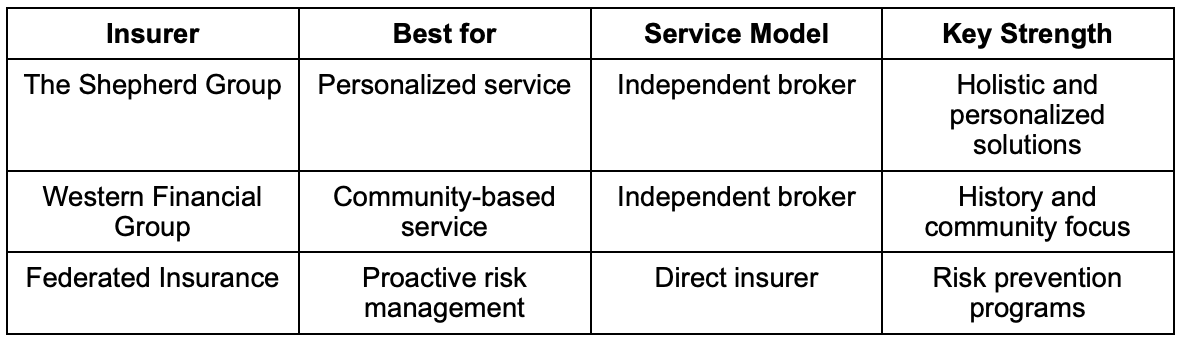
The commercial property insurance providers at a glance
Here are the key features of these commercial property insurance companies for quick comparisons.
Methodology for assessing top commercial insurers
These commercial insurance providers are among the best options for small businesses because they meet the following criteria:
- Tailored solutions for Canadian SMBs: They demonstrate a focus on the unique challenges of small and medium-sized businesses in Canada, not just large national corporations.
- Breadth of offerings: They offer comprehensive commercial property policies and have expertise in other critical areas, such as general liability and cyber insurance.
- Reputation for client support: They have a strong public reputation for offering expert advice, responsive service and fair claims processing.
Value-added resources: They offer tangible benefits beyond the policy itself, such as proactive risk management consultations, educational resources and specialized support services.
Frequently asked questions
How much does commercial property insurance cost for a small business?
There is no “average cost” because every business is unique. Various factors can affect the final price:
– Location: Is it an area prone to floods, wildfires or high crime.
– Construction: Is the building made of fire-resistant materials or combustible ones?
– Protection: How close is the nearest fire hydrant? Is there a monitored fire and security alarm system?
– Occupancy: What does the business do? A restaurant with deep fryers poses a greater fire risk than a small accounting office.
What should you look for in a commercial property insurance policy?
Advise clients to check for the following when assessing insurance policies:
– Replacement cost coverage: Ensure the policy covers the cost to replace items new, not their depreciated value.
– Business interruption insurance: Confirm this vital coverage is included to protect against lost income from downtime.
– Relevant endorsements: Consider coverage for risks specific to their region and business type.
– A true partner: Look for a provider that acts as an advisor, not just a seller.
Does a home insurance policy cover a home-based business?
It depends on the company’s annual revenue and type of operations. The home insurance may provide limited coverage, but it is still best for entrepreneurs to contact their broker for confirmation.
According to Western Financial Group, “If you have customers or employees coming to your home, it is highly recommended that you have a general liability policy. The liability on your home insurance policy will not cover you if a person, such as a client or courier, is injured while on your premises for business-related reasons.”
How can small businesses get a quote for commercial property insurance?
To get a quote for commercial property insurance, they must have all the essential documentation ready. Advise clients to gather key details, such as:
- The property’s full address, year built and square footage
- The age and condition of the roof, electrical and plumbing systems
- A general estimate of the business contents’ value, such as its inventory and equipment
- Any previous business insurance claims
According to Federated Insurance, “There are several key types of commercial insurance that most businesses should have, as well as policies that cover very specific risks. Businesses can benefit by seeking the advice of an insurance advisor or risk management expert when they are reviewing their insurance needs.”