











Canadian farmland values have climbed steadily in recent years across many of the country’s most agriculturally rich provinces, with prices closely tied to the income the land can produce. But lately, that relationship is being tested.
Commodity prices are shifting sharply from day to day, driven by geopolitical tensions, including the ongoing conflict in the Middle East, and broader economic uncertainty, while the cost of inputs just keeps climbing.
The squeeze is prompting questions about where land values go from here.
Tim Hammond, an agricultural real estate specialist and broker at Hammond Realty in Biggar, Sask., about an hour outside of Saskatoon, grew up on a third-generation grain farm. The biggest thing that affects farmland values, he says, is how much revenue farmers generate from it. That’s highly variable from year to year, depending on the weather, cost of inputs, and the biggest factor of all, the price of commodities.
From 2020 to 2023, strong commodity returns fuelled a sustained run-up in land values in Saskatchewan, while tight supply made the climb even steeper. Hammond estimates Saskatchewan once had around 800 farms listed on the MLS system, but that number fell to roughly 200 as the market peaked.
“People had money and there was no inventory to buy,” Hammond said. “It just accelerated and perpetuated that increase.”
Hammond says 95 per cent of his buyers are working producers, and the average sale runs around $1.5 million for roughly 2.5 quarters (or 400 acres).
Source: Farm Credit Canada
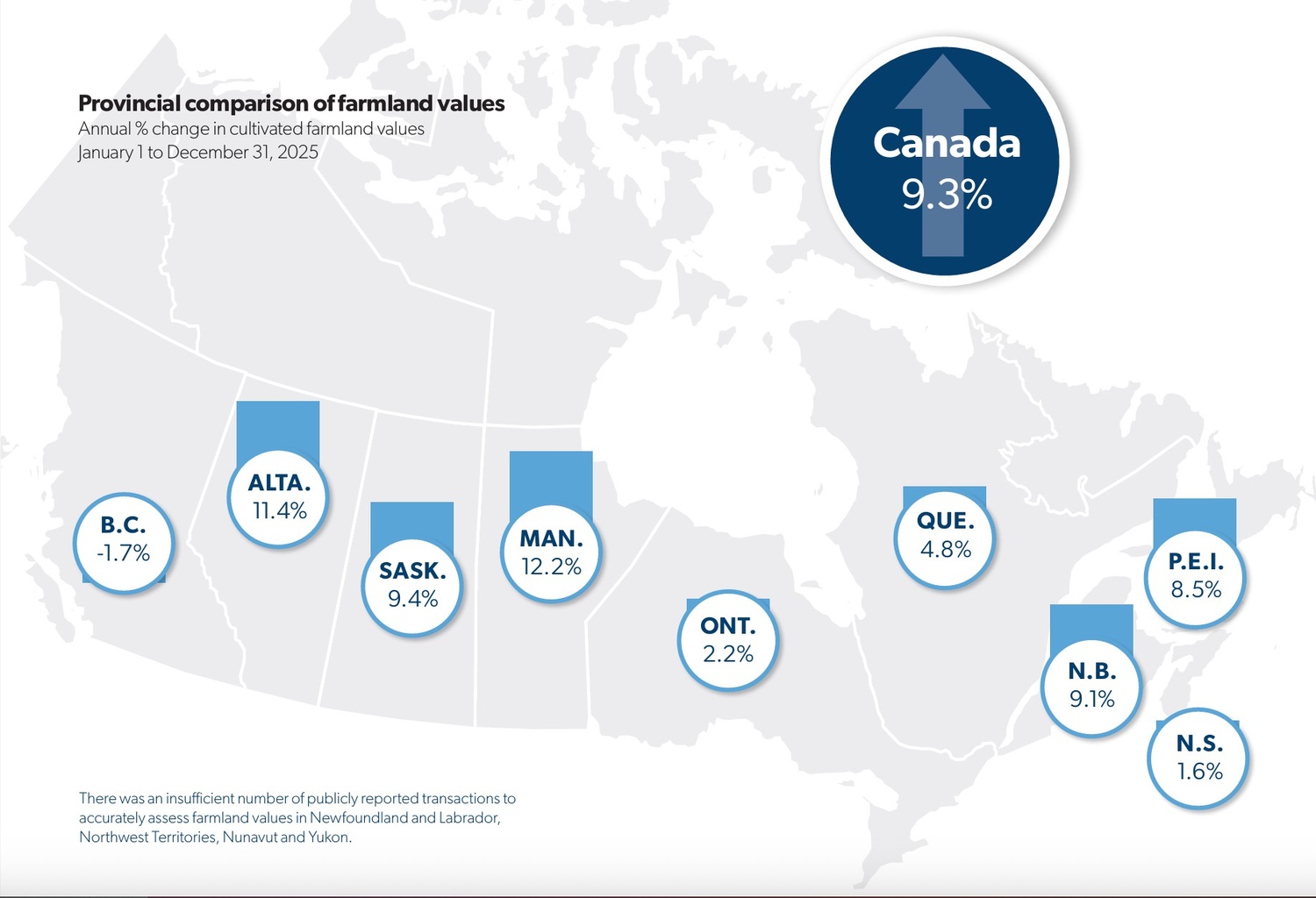
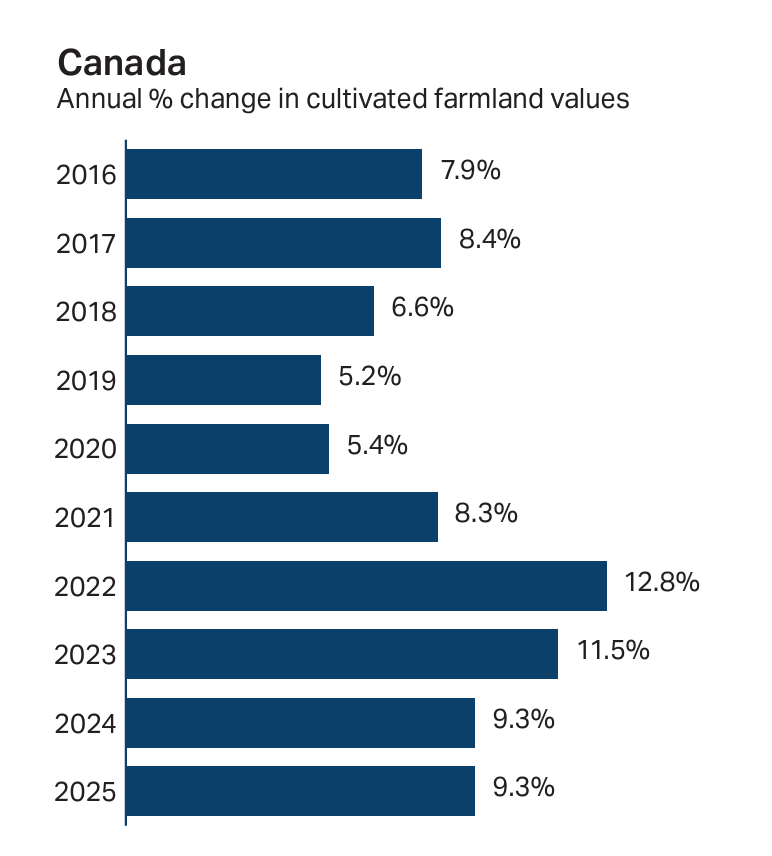
Those dynamics are reflected in the latest national data. Farmland values across Canada rose by an average of 9.3 per cent in 2025, extending a more than three-decade-long upward trend, according to a new report from Farm Credit Canada.
The Prairie provinces drove much of that increase, with Manitoba leading the country at 12.2 per cent, followed by Alberta at 11.4 per cent and Saskatchewan at 9.4 per cent.
The squeeze
But that run-up is now tapering, with Hammond pointing to softening commodity prices. “We really don’t have control over that, and we don’t have control over our markets,” he said. “We’re a price taker.”
Farm earnings from last spring bear that out. According to Statistics Canada, cash receipts – the cash paid to farmers for agricultural products – in Saskatchewan fell seven per cent in the third quarter of 2025 compared to the same period a year earlier, dropping to $4.4 billion.
Source: Farm Credit Canada
The stress is showing up in Hammond’s office. He says calls are coming in from financially stretched producers looking to sell land to pay down debt, with many hoping to lease it back afterward.
“They need to sell some land to liquidate some debt and reorganize,” he said. They aren’t massive sales, he added, but “micro adjustments” being made in the marketplace right now.
Hammond expects more inventory to follow. After years of historically tight supply, he believes that is about to change, and that buyers will soon have more options and more leverage.
“We’ve been so short of land for the last six, seven years, but I think that is going to change,” he said. “Once the inventory starts to build, buyers can be more selective and they’ll have more negotiating ability.”
That added supply will put downward pressure on prices, he says, though there’s still too much momentum for a correction, he said.
“I think we will go sideways for a while, which is healthy,” he said. “It’ll be more of a balanced market instead of an extremely hot market.”
A shifting balance
About two-thirds of farmland in Saskatchewan is owned by the operator, with the remaining third rented from mostly retired farm families, said Hammond, who manages about 80,000 acres of rented farmland.
Many rental arrangements turn into real estate deals when the landlord is ready to sell. When land does change hands, it often happens privately, and that land never comes to market.
“The tenant would not let the landlord put it on the open market,” Hammond said. “He’s like, ‘No, I will buy it.’”
But Hammond thinks that is changing. Prices have climbed to the point where tenants may start to think twice. “I think we’re getting to the point where the prices are so high that the tenant is gonna scratch his head and say, I don’t know if I wanna buy it at that price,” he said. And if the landlord does want to sell, they will have to go to the open market to do that, said Hammond.
Farmers competing against neighbours on P.E.I.
Not long ago, $3,000 or $4,000 an acre seemed like a lot to pay for farmland on Prince Edward Island. Tayler Weeks remembers when the first sale crossed $5,000 an acre, roughly a decade ago.
“It seemed like a massive deal and people were quite upset that farmland in P.E.I. hit that,” he said.
At the time, someone told him it was only a matter of time before the Island hit $10,000 an acre.
“Sure enough, here we are already there,” Weeks said.
According to Farm Credit Canada, average cultivated farmland values on the Island rose 8.5 per cent in 2025, following gains of 1.4 per cent in 2024 and 7.4 per cent in 2023. Demand for potato land remained strong, with good-quality parcels rarely staying on the market for long.
Weeks works with his father and brother at Allan Weeks Real Estate Co. in Hunter River, P.E.I., about a half hour west of Charlottetown. A main driver of prices, as in Saskatchewan, is tight inventory. But on P.E.I., the competition is as intensely local as it is fierce, with dairy and potato farmers needing more acres. In many cases, established operators waiting for a chance to expand all end up chasing the same limited parcels.
“The main thing that we’re seeing is local farmers competing against each other because inventory is so tight,” Weeks said. “If they don’t buy it, someone else is going to come in and pick it up.” Though most buyers are local, Weeks says recent dairy farm sales have drawn buyers from as far as Ontario and Holland.
Like in the Prairies, many agricultural land sales out east never reach the open market, handled privately between neighbouring farmers or between a tenant and landlord.
But when land does list publicly, Weeks and his colleagues already have a sense of who to call. The farmer renting the land typically gets the first opportunity, though whether they can act on it depends on how their previous year went. From there, Weeks says they reach out to four or five local farmers to give everybody a fair chance. “There’s normally a lineup of farmers that want a chance and the opportunity to have a fair shot at buying it,” he said.
The small-market dynamic puts agents like Weeks in a delicate spot. “We like to get along with all of our local farmers and clients,” he said. “If there’s a parcel of land and you have five farmers bidding against each other, one’s gonna be really happy with you.”
Tough business calls
For buyers, the math can be agonizing. Paying a few hundred dollars more per acre to secure a parcel may not seem like much in the moment, but spread over years it adds up, and not everyone is willing to stretch. Weeks says he has watched farmers pass on land only to regret it later.
“We’ve seen people miss out on some good opportunities over the value,” he said. “It’s not our money, so it’s easy for us to talk about it when they’re in those tough scenarios.”
Through it all, prices on the Island have kept climbing. “It does seem like it just keeps growing and growing,” he said.
Weeks expects that to continue into this year, driven in part by the strong returns in P.E.I.’s potato industry, which he says keeps established growers from selling as long as times are good. But he is quick to note how quickly that can change. A poor harvest, a drought, or a shift in global markets could be enough to put a for sale sign up. Last summer’s dry season, he says, hurt some farmers.
The longer-term picture is shaped by succession. As farmers age, those with children willing to take over the operation are in a different position than those without.
Weeks sees it play out differently across sectors. Potato farming tends to bring younger generations in early and keep them involved. Dairy is more complicated. A farm that once supported one family comfortably may not be able to support two, making it hard for the next generation to step in without significant equity behind them.
When there is no one to pass the farm to, the land eventually comes to market. “I could see, not this year, but soon, there’ll be some larger farmers just wanting to cash out,” Weeks said.



Courtney Zwicker is a digital reporter and associate editor for REM. Based in Atlantic Canada, she has over a decade of experience covering daily business news.




Good article