








Canada’s recreational real estate market, which saw a surge in demand and double-digit price gains over the past two years, is expected to soften in 2023 due to waning activity and economic uncertainty, according to a report by Royal LePage.
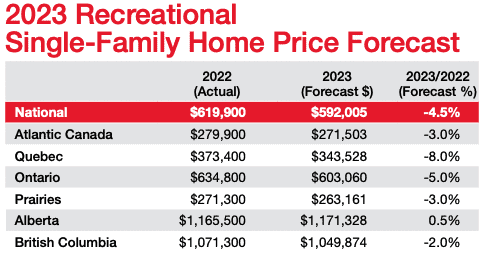
The aggregate price of a single-family home in Canada’s recreational regions is forecast to decrease by 4.5 per cent to $592,005 in 2023 compared to 2022. However, the national aggregate price would remain more than 32 per cent above 2020 levels.
Canada’s recreational markets
All of Canada’s provincial recreational markets, with the exception of Alberta, are forecast to see a decrease in single-family home prices in 2023.
Quebec and Ontario are expected to see the largest recreational property price decreases in 2023, with forecasted declines of 8.0 per cent and 5.0 per cent, respectively, compared to 2022
Source: Royal LePage
Condo vs. house
When broken down by housing type, the aggregate price of a single-family waterfront property increased by 9.5 per cent year-over-year to $736,900 in 2022, while the aggregate price of a condominium rose 16.6 per cent to $432,000 during the same period.
Reason for the softening market
Reduced demand due to economic uncertainty and a lack of available housing stock (which has helped to keep prices stable) is the reason behind the softening of the recreational market.
“After two years of relentless year-round competition, Canada’s recreational property markets have slowed and returned to traditional seasonal sales patterns,” said Phil Soper, president and CEO, Royal LePage.
“While interest rate hikes have less of an impact on the recreational market than homes in urban settings because families typically put more money down and borrow less, general consumer inflation combined with a severe lack of inventory has dampened sales activity.”
Soper adds, “Buyers who are active in today’s market appear willing to wait for the right property – a sharp contrast to what we experienced during the pandemic.”
While low inventory poses a challenge for buyers, the coinciding contraction in demand has resulted in a return to more normal market conditions.
Expert opinions
According to a survey of more than 200 Royal LePage recreational real estate professionals across the country, 57 per cent of respondents reported less inventory this year compared to last year.
At the same time, 51 per cent of respondents said they have witnessed less demand for recreational properties in their region compared to this time last year.
However, Soper noted that recreational homebuyers tend to purchase for leisure and life-enriching purposes, unlike many city buyers who may need to acquire a principal residence quickly.
Impact of the pandemic
Nationally, 28 per cent of recreational property experts surveyed said that the trend of homeowners moving back to urban or suburban communities after relocating to their region full-time during the pandemic is somewhat common; 56 per cent of experts reported this trend was not common in their market.
Atlantic Canada, a pandemic relocation hotspot, recorded the highest percentage of experts who said the return to urban or suburban areas is somewhat common in their region, at 46 per cent.
“During the pandemic, with offices closed and people working from home, Canadians discovered that a recreational property could double as a principal residence, complete with capital gains exempt status,” Soper said.
“For many, living in cottage country full-time has lost its romantic shine, meaning we are back to viewing the cottage, cabin and chalet as a weekend and summer escape from urban living.”
Read the full report from Royal LePage, including provincial breakdowns, here.