











A fourplex with 10 per cent down will get a client’s attention. Before anyone writes an offer, though, the agent needs to know whether the building is new.
The federal government’s Budget 2026, tabled Nov. 5, introduces mortgage-insurance options for smaller rental properties. The new three- and four-unit rules cover construction and newly built properties. An existing fourplex does not qualify just because it has the right number of doors.
Start with the building
The budget’s housing chapter allows financing of up to 90 per cent of completed value for construction or purchase of newly built three- and four-unit properties. The maximum amortization is 30 years. There is no property-value ceiling, and the borrower does not have to live in one of the units.
The amount is based on appraised completed value, so 10 per cent of a builder’s cost estimate may not be enough cash. A lower appraisal or a cost overrun can leave the client with a larger bill.
For buildings with five to 50 units, Finance Canada’s parameters open mortgage insurance to private insurers for construction, purchases, refinances and renewals. New construction can qualify for up to 90 per cent of value and a 50-year amortization. Other transactions are capped at 85 per cent and 40 years.
For term financing on those buildings, minimum debt coverage is 1.15 for a five-year term or 1.10 for a 10-year term. Borrowers need net worth of at least 25 per cent of the requested loan, subject to a $100,000 minimum and assessed on Canadian-held assets. The units must be self-contained and held under a single legal title or ownership structure. Buying several separately titled properties will not get a client over the five-unit threshold.
These rules apply to insurance applications lenders submit on or after Feb. 1, 2027. A client planning a purchase around them needs to ask the broker when a participating lender could approve and fund the loan.
Check the construction loan separately
The stated amortization and debt-servicing requirements do not apply during construction. Insurers use their own underwriting criteria for that stage, before the building moves into long-term financing.
Ask how much the lender will advance at each stage and how much the borrower has to put in first. Get the conditions for the completed building’s mortgage at the same time. A client needs to know who covers a shortfall if the appraisal or rental income comes in below expectations.
Enough equity to start building may not be enough to finish. Construction delays mean more interest. A slower lease-up means less rent arriving while payments are due. The client’s cash budget needs room for both.
For new three- and four-unit term financing, borrowers also face gross and total debt-service limits of 39 and 44 per cent, respectively, and the minimum qualifying rate. At least one borrower or guarantor must have a credit score of 600 or more.
Check the client’s qualification with the broker before treating projected rent as the answer to every financing question.
Show the payment and the remaining debt
Consider a $1-million mortgage at 5 per cent, with monthly payments and Canadian semi-annual compounding. Hold the rate and loan amount constant so the comparison shows what a longer amortization changes.
The monthly payment is about $5,337 over 30 years, $4,788 over 40 years and $4,505 over 50 years.
Moving from 30 to 50 years frees up roughly $832 a month. That can give a rental property more room to cover expenses.
After five years, the 30-year borrower owes about $917,617. The 50-year borrower owes $974,099. The lower payment leaves roughly $56,482 more debt outstanding at that point.
Put that remaining balance beside the monthly payment when you show the comparison to a client. More debt will be exposed to the rate available at renewal. The longer schedule also costs more in total interest if the loan runs to the end at the assumed rate.
The example excludes insurance premiums, fees and operating costs. It compares repayment schedules rather than lender products.
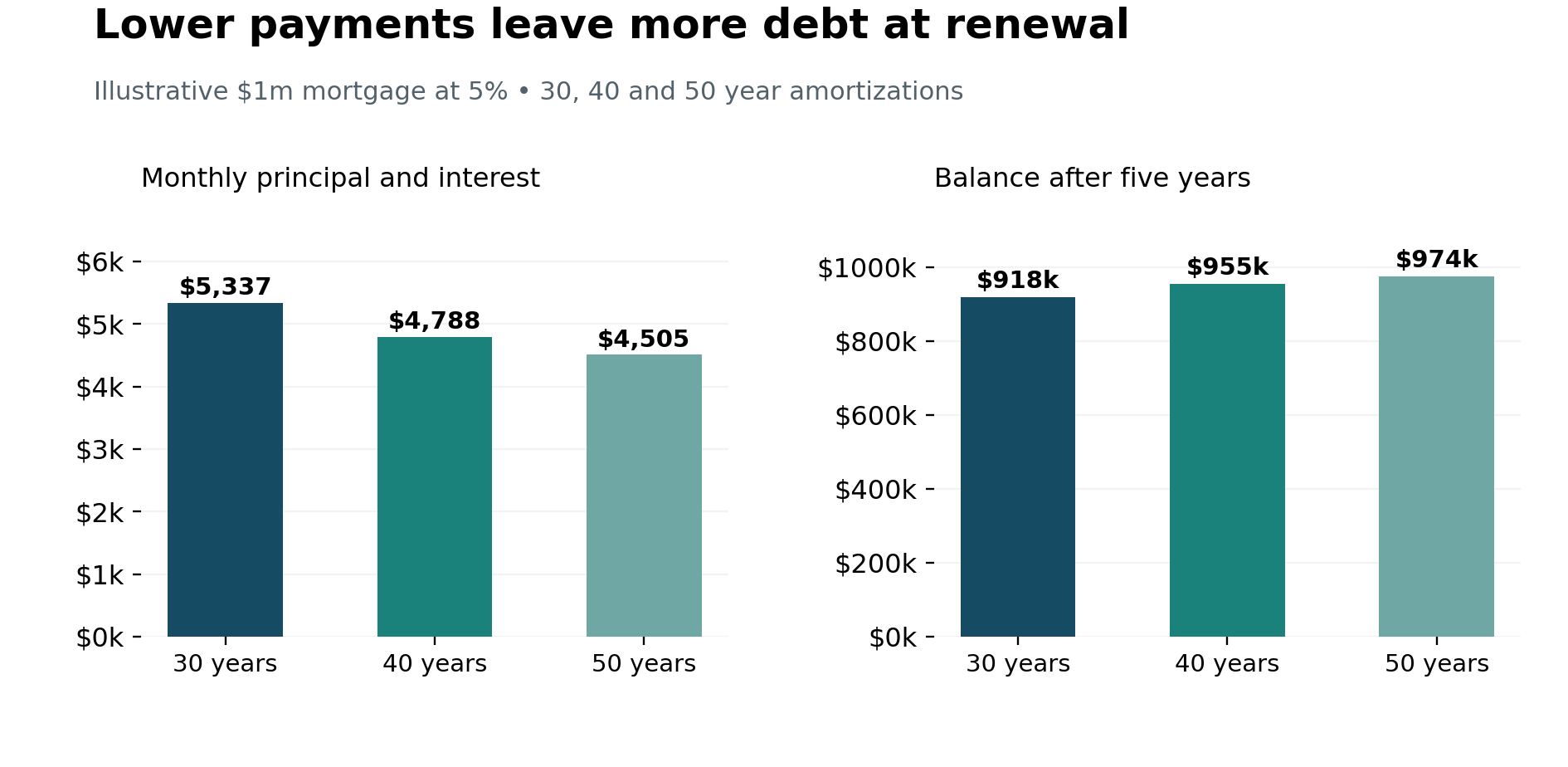
Illustrative calculation: $1-million principal at a constant 5 per cent nominal annual rate compounded semi-annually, with monthly payments. Excludes premiums and fees. Amortization is the repayment schedule, not the mortgage term. The new three- and four-unit option is limited to 30 years.
Ask the broker to price the alternatives
Borrowers already have access to the Canada Mortgage and Housing Corp.’s Standard Rental Housing and MLI Select programs. Those need to be part of the comparison when private insurers begin offering the new loans.
MLI Select’s terms depend on commitments to affordability, energy efficiency or accessibility. The maximum loan amount and longest amortization come with conditions. The client needs to understand what those commitments cost and what reporting is required, alongside premiums and guarantees. Standard Rental Housing has its own requirements.
Ask for the insurance premium and required reserves in dollars so the client can see the full cash requirement.
Bring the property details to the broker
For an investor, collect the rent roll, leases and actual expenses. Check that the units are legal. Allow for vacancies and repairs, and verify that any proposed rent increase is achievable and lawful before using it to support the loan.
A seller may see more borrowing capacity as a reason to raise the asking price. The buyer still has to justify that price against local rents, comparable sales and the other properties for sale. Better financing may bring more buyers into the search, but it does not settle what this building is worth.
For clients buying a home to live in, the budget separately proposes raising the price ceiling for optional mortgage insurance from $1 million to $1.5 million. It also proposes 30-year amortizations where the borrower is a first-time buyer or the home is newly built. Have the broker check eligibility and timing for that proposal. The Feb. 1, 2027, start date for the rental rules cannot simply be applied to it.
Before making an offer, give the broker enough information to assess the actual deal.
| Before the offer | Bring to the broker |
| Identify the property | Legal unit count, title structure and new or existing construction |
| Identify the transaction | Construction, purchase, refinancing or renewal |
| Budget the cash needed | Equity, draws, reserves, contingencies and closing costs |
| Test repayment | Borrower qualification, verified income and term-financing conditions |
The next call should produce a financing estimate for the property your client wants to buy, with the cash required and the conditions still to meet. Use that estimate when setting the offer price and closing date.



Daniel Foch is the Chief Real Estate Officer at Valery.ca, and Host of Canada’s #1 real estate podcast. As co-founder of The Habistat, the onboard data science platform for TRREB & Proptx, he helped the real estate industry to become more transparent, using real-time housing market data to inform decision making for key stakeholders. With over 15 years of experience in the real estate industry, Daniel has advised a broad spectrum of real estate market participants, from 3 levels of government to some of Canada’s largest developers.
Daniel is a trusted voice in the Canadian real estate market, regularly contributing to media outlets such as The Wall Street Journal, CBC, Bloomberg, and The Globe and Mail. His expertise and balanced insights have earned him a dedicated audience of over 100,000 real estate investors across multiple social media platforms, where he shares primary research and market analysis.