










The views expressed in this column are solely those of the author.
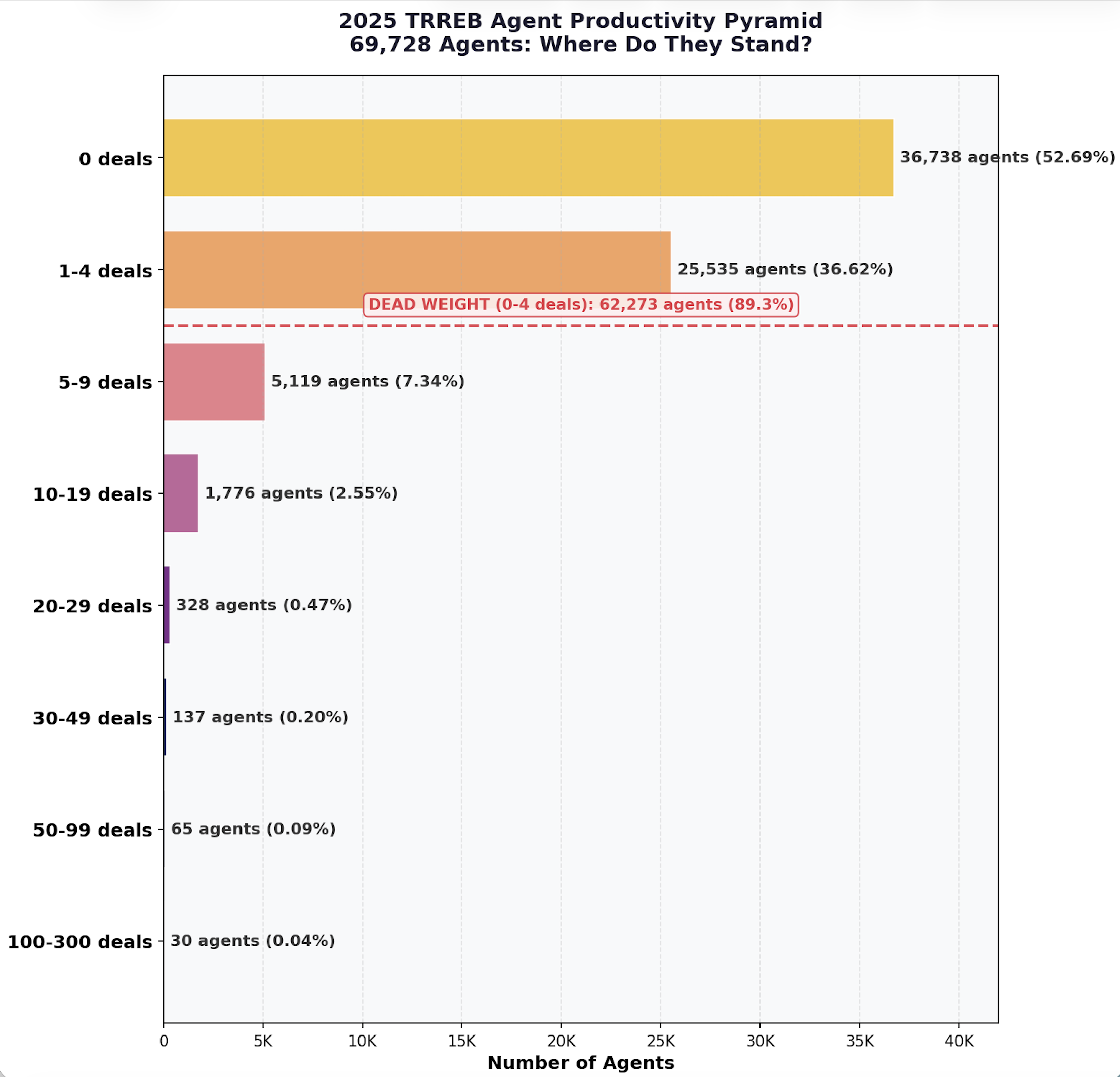
As of Dec. 31, 2025, there were 69,728 licensed real estate agents in the Toronto Regional Real Estate Board (TRREB), but only 560 of them closed 20 or more transactions in 2025, according to TRREB data compiled by Redatum. That is just 0.8 per cent of the industry.
Five years ago, there were 1,975 agents at this elite level. While the industry’s attention has been hyper-focused on market corrections and interest rate hikes, a more existential crisis has been hiding in plain sight: the systematic replacement of productive real estate agents with non-productive ones.
An analysis of more than 800,000 TRREB transaction sides from 2021 to 2025 reveals a pattern that fundamentally changes how brokerages and team leaders must approach talent acquisition. This is not merely a market correction. It is a systemic skills mismatch story — one where association business models, social media performance art and a 25-year bull market converged to create an industry built on illusion rather than skill.
The numbers don’t lie: a crumbling foundation
The current state of the industry’s productivity is staggering. As of Dec. 31, 2025, 36,738 TRREB agents — 52.7 per cent of the total pool — closed zero transactions in 2025. Another 25,535 agents (36.6 per cent) closed between one and four transactions, which is barely subsistence level.
Combined, 89.3 per cent of licensed agents completed four or fewer deals in an entire year. These are not real estate careers; they are expensive hobbies subsidizing industry overhead.
In 2021, a functioning market meant real competition for a genuine talent pool — nearly 7,000 agents were closing 10 or more transactions a year. But between 2021 and 2022, the same enrollment machine that always ran kept running — into a wall. In a single year, 9,415 additional agents closed zero transactions while 5,460 active producers left the productive ranks.
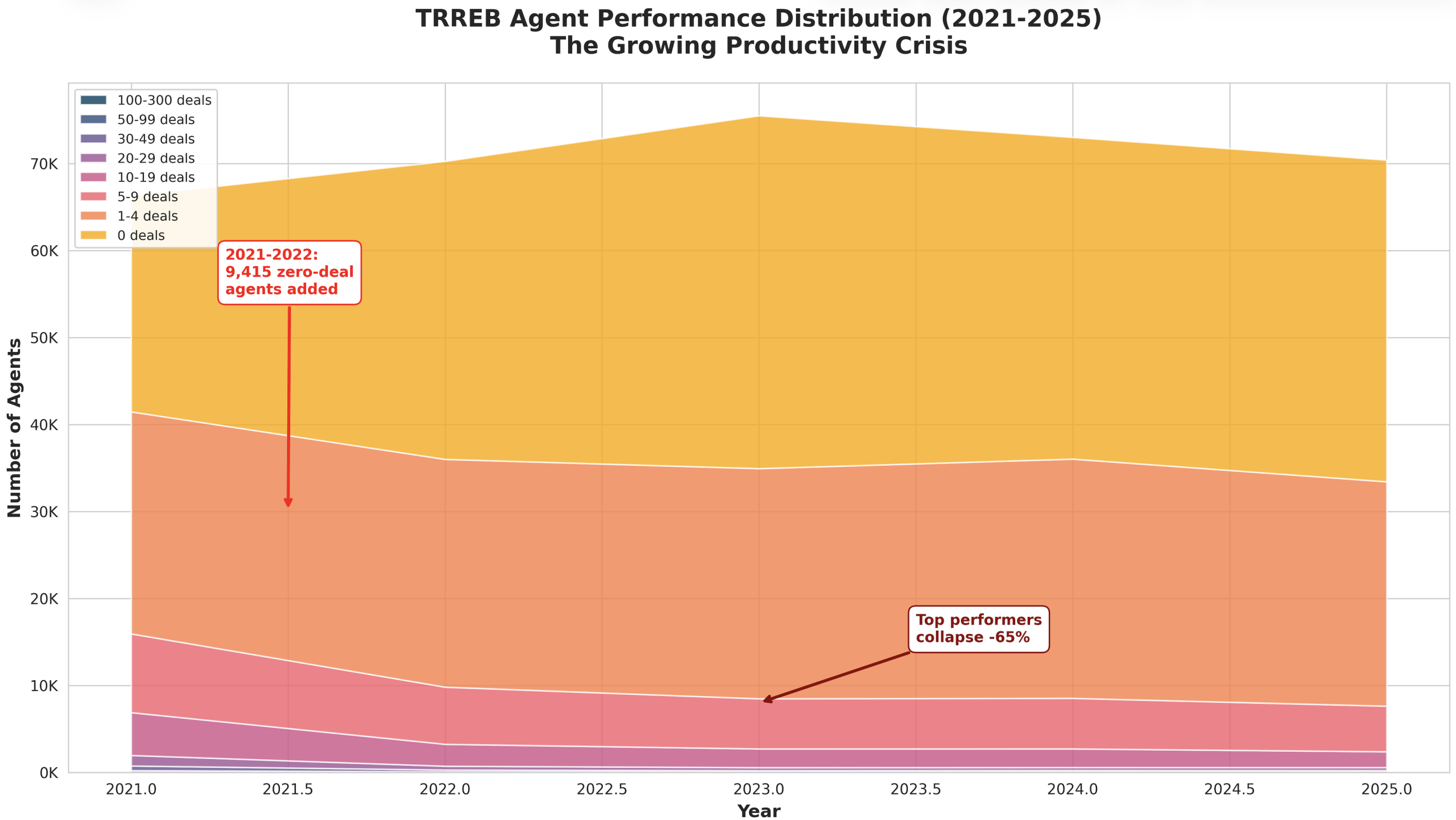
Over the past five years, the productive core of agents closing 10 or more deals collapsed by 65 per cent, and the elite tier was decimated by 70 per cent, according to TRREB data via Redatum. The industry did not get smaller; it simply replaced all-stars with benchwarmers. What should be a stable pyramid — many moderate producers supporting a small elite tier — has completely inverted.
Three systemic forces behind the collapse
Understanding why this happened requires looking past the housing market and examining three systemic forces that created this vulnerability.
1. The association incentive structure
Professional real estate associations operate on a business model where revenue is tied to course enrollments and membership growth. Success for these organizations is measured by how many people enter the profession, not how many actually succeed in it.
This model naturally creates oversupply. Every year, thousands of hopeful new agents are minted, paying $15,000 in education, first-year licensing, brokerage and marketing fees. The structural disconnect is severe: those who profit from training and licensing do not bear the cost of this oversupply. Brokerages and teams absorb the operational burden of an inflated talent pool, while associations benefit from continuous growth.
2. Social media and the illusion economy
The second force is the transformation of real estate marketing from property-focused to lifestyle-focused. Amplified by social media algorithms, the industry adopted a “fake it till you make it” template.
Agents began marketing a lifestyle — leased luxury vehicles and designer clothes — rather than competence. In a rising market, this worked because buyers and sellers wanted proximity to perceived success. But the algorithm rewarded the wrong content, turning the profession into a caricature. For an agent closing two deals a year, the cost of performing success — leased vehicles, designer clothes, content production — routinely consumes the majority of their net income. Flaunting wealth in a market where sellers are losing value on their homes is not aspirational; it is entirely out of touch.
3. The end of 25 years of ‘easy mode’
From 1997 to 2022, Toronto real estate operated in what might generously be called “easy mode” — not because agents didn’t work hard, but because a market that rose almost every year rewarded presence over precision. With few exceptions, prices consistently trended upward, inventory shortages created automatic competition, and marketing simply meant listing a property on the MLS and waiting.
In 2015, competence meant answering your phone and showing up on time. In 2025, competence requires data-driven market analysis, sophisticated pricing strategies, genuine negotiation skills and the ability to counsel clients through market anxiety.
When the market shifted in 2022, “easy mode” abruptly ended. The skills that worked for two decades became instantly obsolete. Elite agents either slowed down or retired. Mid-tier and lower-tier agents, lacking the necessary skills for a difficult market, froze. They are now waiting for a “normal” market to return — but the market is not going back.
The compliance nightmare and the path forward
Brokers often point to the “middle tier” of agents as a development pipeline, but that demographic has collapsed too, dropping approximately 40 per cent since 2021. Meanwhile, the 25,535 agents doing one to four deals are just natural attrition waiting to happen.
The uncomfortable reality brokerages must face is the massive compliance risk this top-heavy structure creates. FINTRAC and regulatory bodies require brokerages to monitor every single licensed agent. In 2025, there are 36,738 zero-transaction agents carrying potential liability exposure, consuming administrative bandwidth and generating zero revenue. One compliance violation from a “zombie” agent can cost a brokerage more than a productive agent generates in a year.
The industry has reached a new, unstable equilibrium. To survive the transition over the next three to five years, the industry playbook must be rewritten.
What needs to change
Brokerages must implement performance standards. It is time to prune the roster. The legal and operational liability of housing thousands of zero-deal agents far outweighs the marginal desk fees they provide. Quality must take precedence over quantity.
Agents must invest in skills, not appearance. The era of lifestyle marketing replacing competence is over. Agents must abandon the performance art and invest heavily in learning sophisticated pricing, creative marketing and data forecasting.
Associations must align incentives with success. The industry cannot sustain a model that profits off failure.
The market itself is still transacting; it is the agent population that is broken. The brokerages and Realtors who recognize that this is a permanent skills obsolescence crisis — and not a temporary market condition — are the only ones who will thrive in the new equilibrium.



David Ursino is the Managing Broker of RE/MAX Premier Inc. and the creator of BrokerBotics.ai teaching real estate agents how to use AI effectively. Registered in Ontario since 2007 and a managing broker since 2018, he has overseen more than 500 agents across his career. He has delivered TRESA compliance and province-wide training programs to agents from Ontario, and currently focuses on integrating AI into brokerage operations, agent development, and administrative workflows.




Wow! “Incentives to join not succeed” and “1997-2022 boom market”
Keep writing these posts!
Great article and I couldn’t agree more. We see the same thing in Kelowna BC and across the country. It’s time for skills to be enhanced by all Realtors.
The profession spent so much time on ensuring that there are so few barriers of entry that we now have this overwhelming number of agents, many of whom are classified as Zombie agents. Now those organizations that depend on the quantity rather than quality of agents are of the impression that the profession would be better off with more education. Often those that offer to teach are ones that struggle to sell. The simple fact, those whose commit to this profession will acquire the education they feel they need to succeed.
RECO should allow consumers, when they do a registrant search, to view all the details of the registrant, such as bankruptcy, charges and convictions but most of all “other employment”.
I agree with David but, from the larger number of agents one must subtract all commercial agents which would be at least 2,500 in TRREB and higher. And then there are many of us who work in both residential and commercial and we can have a weak year in res but a great year in commercial.
Then subtract all brokers and managers who do not sell – a decent number.
Then subtract real estate appraisers who hold registrations and TTREB membership but just to get MLS access.
And many property managers are also TRREB members.
I have been advocating for years that the old 80-20 rule died out when teams rose. We also have to look at teams. In many teams the deals are made by team members but then posted under the team leader who shows great numbers in volume – of deals they never personally made.
I believed for years that 5-7% of agents controlled most the of market and still do. And I believe that holds true in most Canadian cities.
One thing, I was on a podium to speak with Mark Weisleder, well known lawyer and speaker and Mark looked at the attendees and whispered to me that the wrong people were in the audience. I replied to Mark that I did not understand, some leading agents were sitting there that day. Mark smiled and said, “that’s the problem, the agents who need to be in attendance seldom are.”
Great article and thoughtful comments. The tension between quantity and quality has been built into the structure of our industry for a long time.
What’s changing now is that the market is no longer carrying that gap, it’s exposing it, in real time, in the conversations and negotiations that actually move deals forward.
How were the numbers reported? If the agent was a trreb member but also a member of another association not member of trreb and that is were the deals were made, they would not show up on trreb data?