







This article was created with AI using the episode transcript, reviewed and approved by show co-host Andrew Fogliato, and edited for publication by Courtney Zwicker.
Real estate agents have access to better tools than they have ever had.
CRMs can automate reminders. Artificial intelligence can draft emails, build landing pages, create videos and turn one conversation into a month of content. A new lead can be contacted within seconds.
And yet the follow-up still often looks exactly the same.
A lead comes in. The agent calls once. Nobody answers. The agent decides the lead was bad and goes looking for another one.
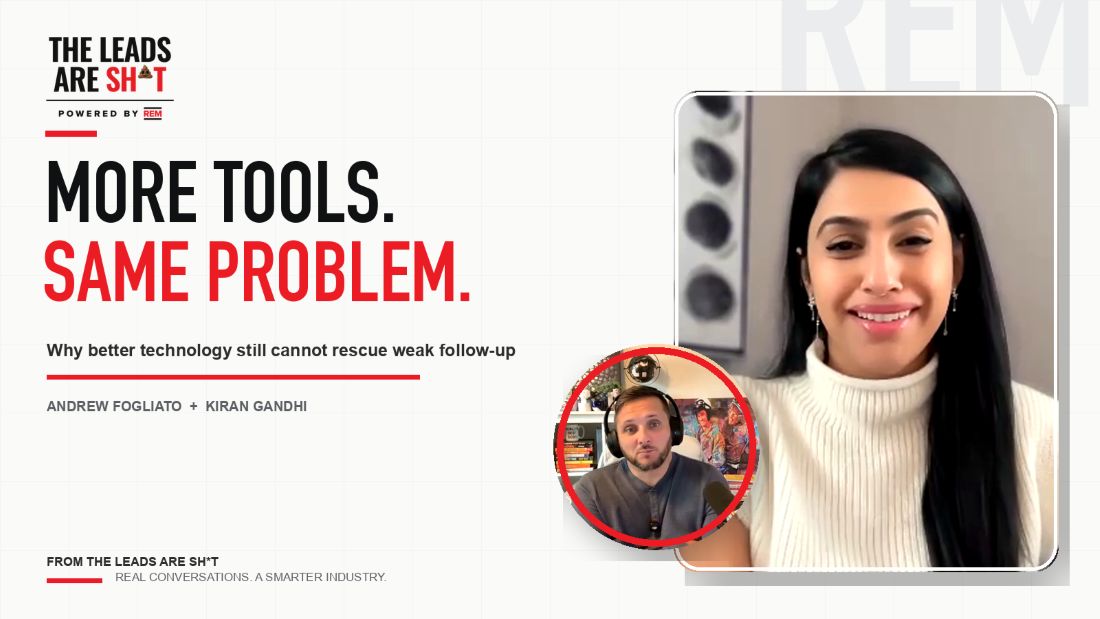
That disconnect became one of the main themes when Andrew Fogliato was joined by guest co-host Kiran Gandhi on a recent episode of The Leads Are Sh*t.
The tools got better. The system did not.
Stop treating the lead like a transaction
When Fogliato asked Gandhi which systems agents are most often missing, her answer was immediate: follow-up and staying in touch with the database.
The problem starts with the way agents think about the person who just filled out a form.
The agent sees a lead. The person on the other side sees a decision they have not finished making.
They may be curious about a neighbourhood, trying to understand what they can afford or wondering whether now is the right time to move. They might not know the agent. They probably do not trust the agent yet. Their first interaction with a website is not the same thing as a decision to book an appointment.
That does not make them a bad lead. It means the follow-up has to meet them where they are.
Trying to move directly from an online registration to an immediate transaction skips the work required in between. Good follow-up reduces uncertainty, answers the next question and gives the person a reason to continue the conversation.
A simple follow-up video can change the conversation
Gandhi offered a practical example agents can put to work immediately.
After attempting the first phone call, record a short video that introduces you and explains what happens next. Keep it to roughly 30 to 60 seconds. Put a face and voice to the name, acknowledge that you tried to reach them and point them toward something useful.
The message can be simple:
- Introduce yourself.
- Mention that you tried calling.
- Explain why you are following up.
- Share one or two useful resources.
- Let them know you will try again.
- Make it easy to reply with a question.
The resources should fit the reason they reached out. That might mean a market report, a buyer’s guide, information about a property or an explanation of how your process works.
The point is not to impress someone with a complicated production. The point is to make the next interaction feel warmer and more familiar.
An agent can use one recorded introduction as part of a repeatable follow-up process. It does not need to be recreated from scratch for every lead. A personalized opening can be added when the opportunity justifies it, but the underlying system should already exist.
Use AI to move the person forward
The episode included plenty of discussion about AI, but the useful dividing line was not whether an agent uses it.
The better question is what the tool helps the agent accomplish.
If an agent spends an afternoon refining a prompt but has no more conversations at the end of the day, the tool did not move the business forward.
If the same technology helps an agent create a useful follow-up page, organize resources, answer a question faster or turn a real conversation into content, it has a job.
Fogliato and Gandhi explored the idea of a rapid follow-up page created for an individual prospect. It could include the agent’s short video, relevant resources, matching listings and a clear next step. Once the basic system exists, a page could be adapted quickly without building everything from scratch.
They also discussed a “talking house” that could answer questions about a property through a voice interface. The technology is interesting, but the useful part is what sits underneath it: the system gives someone an immediate answer and helps move them toward a conversation with the agent.
That is different from producing more generic content because the technology makes it easy.
Agents are becoming interpreters
For years, the real estate industry talked about agents no longer being the gatekeepers of listing information.
AI pushes that change further. Consumers can now access more market information, explanations and automated advice without speaking to a professional.
Trying to protect access to information is a losing strategy.
The opportunity is to help people understand what the information means for them.
A consumer might arrive with an automated valuation, a set of comparables or clauses drafted by AI. The agent’s value is not simply having more information. It is knowing what applies, what does not, where the risk sits and what decision should come next.
That requires judgment, context and the ability to communicate clearly. It also requires trust.
The technology can summarize the data. The professional still has to help a person navigate the consequences.
Measure the conversations, not the tools
Agents are constantly shown another platform, automation or content system they are told they need.
It is easy to confuse learning a tool with building a business.
Fogliato’s proposed North Star is much simpler: does the thing you are working on help you have more useful conversations with people?
That question can be applied to almost anything:
- Did the CRM make the follow-up more consistent?
- Did the video make the next call easier?
- Did the landing page answer the question that brought the person to you?
- Did the content attract the right people or simply create more views?
- Did the automation give you more time to speak with clients?
If the answer is no, the tool may be interesting without being important.
Short-form gets attention. Long-form earns consideration.
The same standard applies to content.
Short-form video can introduce an agent to more people. It is useful for attention, but attention alone does not explain what it is like to work with someone.
Long-form content gives a serious prospect the opportunity to understand how an agent thinks.
One example discussed during the episode was a public version of a listing presentation. The agent could explain how they prepare a home, determine a pricing strategy, market the property and guide the seller through the process. It would not need to be called a listing presentation. It could simply show a prospective seller what working with the agent looks like.
The audience may be smaller than the audience for a quick reel. That is not necessarily a problem. Someone who spends 15 or 20 minutes learning how an agent sells a home is showing much stronger intent than someone who watches a few seconds of a generic market update.
The same long-form video can also become the source for shorter pieces of content. The important order is to create something useful first, then use the tools to distribute it.
Fix the system before buying another tool
Most agents do not need another platform before they can improve their follow-up.
They need to look at what happens after the lead arrives.
What does the person receive? What question gets answered? What builds familiarity? When does the agent try again? What happens if the person is interested but not ready?
The technology can make each step faster. It cannot decide that those steps matter.
That is still the work.
Join the conversation live
The Leads Are Sh*t is a weekly strategy lab where Andrew Fogliato and Taylor Hack break down what is working, fix what is not and test ideas inside an actual real estate business.
Join the show live every Thursday at 2 p.m. ET to ask a question, take the hot seat and stay for the off-the-record After Show, which is not included in the replay.
Register once and save your spot for the next live session.
Related Posts

How Tom Storey turned YouTube into 40% of his real estate business
Tom Storey attributes 40% of his real estate business to YouTube by using long-form videos to build trust and answer buyers’ questions, transforming his approach to client engagement.

Deploy this five-star lead system and win more clients in 2026
Realtors often fill their CRMs with “maybes.” Learn how the five-star lead system can help you identify serious clients and protect your valuable time in 2026.

How to turn one listing into three
Most agents overlook the hidden business potential within a single listing. Learn how to tap into neighbours, unrepresented buyers, and referral opportunities to maximize your success.



Content by REM Bot has been created with the assistance of AI. Audio and video interviews, conducted by our team with real people, are transcribed and repurposed into text for those who prefer reading. REM Bot articles are reviewed by staff before publication to ensure factual accuracy and maintain editorial standards.