








This article was created with AI using the episode transcript, reviewed and approved by show co-host Andrew Fogliato, and edited for publication by Courtney Zwicker.
There are worse things for a real estate agent to be known as than “the trash guy.”
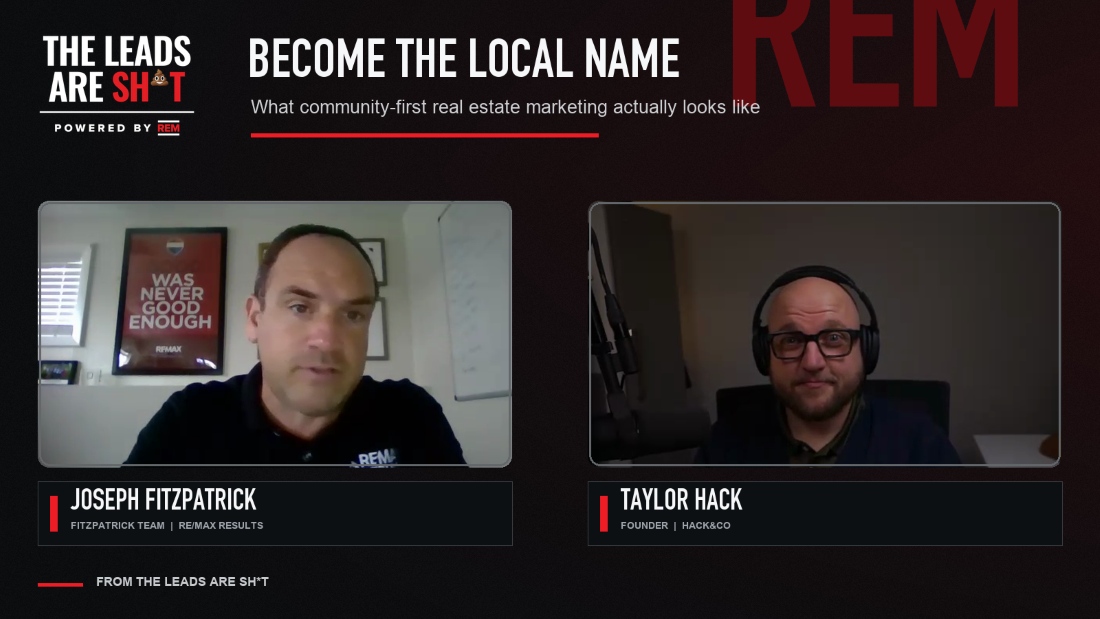
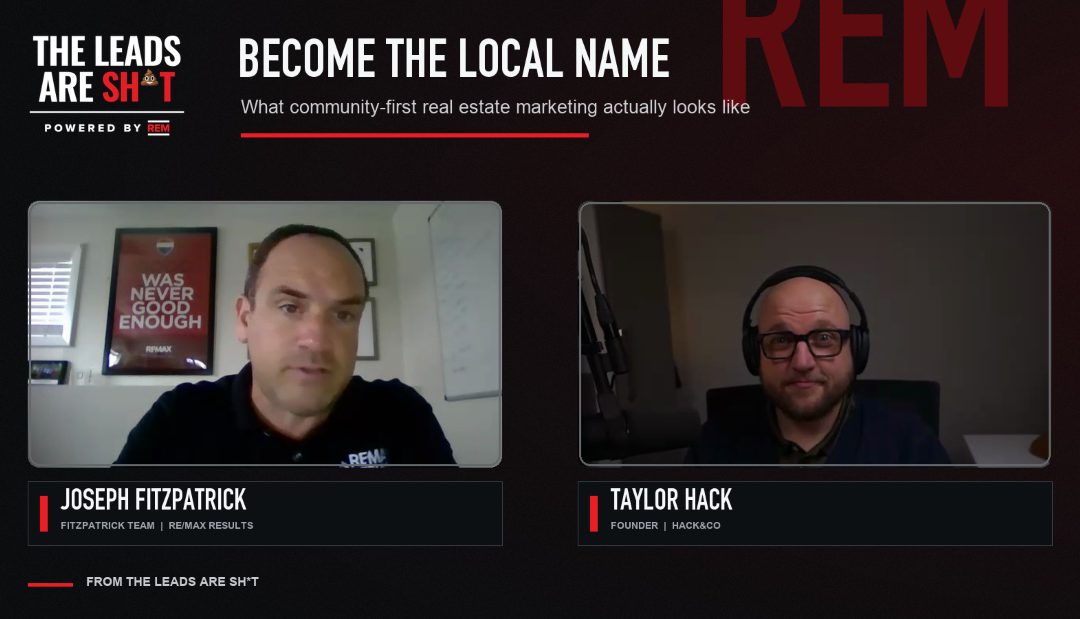
Joseph Fitzpatrick learned that when he was crossing the street with his daughter and heard a child point him out to their mother. The child recognized him from Clean It Up Joe, the community cleanup campaign that Fitzpatrick started after posting a frustrated Facebook rant about overflowing trash during tourist season.
The rant became a GoFundMe campaign. The campaign became a repeatable community program. Years later, people still photograph overflowing trash, tag the location and use the Clean It Up Joe hashtag. Fitzpatrick and other volunteers then respond.
That story came up during a recent episode of The Leads Are Sh*t with Taylor Hack, and it gets at something many real estate professionals struggle to understand.
The best local marketing often does not begin with a marketing campaign. It begins with doing something useful enough that people remember who did it.
Specific beats generic
Most agents want to be known in their community. The problem is that “being involved” is too vague to be memorable.
Clean It Up Joe works because it is specific. The name is easy to remember. The action is easy to understand. The community knows what to do when it sees a problem, and Fitzpatrick’s name is attached to the response.
The same is true of the Fitzpatrick Team running club. The team buys entries to local races and gives them to community members who are willing to train through a couch-to-10K program. They run four 10-week programs a year, which means the activity is happening for roughly 40 weeks of the year.
Neither idea asks someone to list a house. Both create repeated, positive contact with people in the community.
That repetition matters. A one-time sponsorship may generate a photo and a social post. A useful program that people encounter throughout the year has a chance to build actual recognition.
Consistency creates the brand
Fitzpatrick’s examples are different, but they share a common structure:
- Pick an activity people can easily understand.
- Make it useful before asking for anything in return.
- Repeat it long enough for the community to associate it with you.
That last step is where many agents fall off.
Fitzpatrick did not describe a single tactic that suddenly made him the local name. He described years of consistent activity: the running club, the cleanup campaign, community events, social media, direct mail and prospecting.
That is less exciting than a viral growth hack, but it is also more practical. Recognition compounds when the activity is specific enough to remember and consistent enough to believe.
Connect the marketing to client value
Community visibility is only part of the strategy. Fitzpatrick also described a weekly letter campaign built around the needs of active buyers.
Instead of only setting up an MLS search and waiting for matching properties, his team identifies the neighbourhoods a buyer wants and writes hundreds of targeted letters on the buyer’s behalf. The immediate purpose is to show the buyer that the team is actively trying to create opportunities, not just watching a portal.
According to Fitzpatrick, the campaign also created listing opportunities. By mid-September, he said it had contributed to six closings and approximately $60,000 in gross commission income in his market, compared with an annual mailing cost of roughly $30,000.
Those numbers are not a universal return-on-investment promise. They are gross commission figures from one team in one market, and the campaign may perform differently elsewhere. The useful lesson is the structure: one activity can serve the current client, introduce the team to future sellers and build local awareness at the same time.
That is much stronger than sending generic “I have a buyer” letters with no real buyer need behind them.
Make the activity easier to do
Fitzpatrick also shared a practical adjustment for agents who avoid prospecting because the ideal version feels too difficult.
His team calls it “door knocking slash door hanging.” An agent may set out to knock on 50 doors, but if someone is rude, the weather turns or the agent simply loses momentum, they can leave the material at the remaining homes instead.
The goal is not to pretend a door hanger is identical to a conversation. The goal is to keep a bad moment from ending the entire activity.
He applies the same thinking to phone prospecting. Rather than demanding 400 calls a week from every agent, he asks for one focused hour a day and accepts that consistency is more valuable than an unrealistic target that gets ignored.
Real estate marketing is often discussed as a search for the perfect campaign. This episode offered a more grounded approach.
Choose useful work. Make it easy to understand. Build a system you can keep doing. Give people a reason to remember you before they need to hire you.
Being known as “the trash guy” may not sound like the polished personal brand most agents imagine. In Fitzpatrick’s case, it means his community knows his name, knows what he does and knows that he shows up.
That is a brand.
Join the conversation live
The Leads Are Sh*t is a weekly strategy lab where Andrew Fogliato and Taylor Hack break down what is working, fix what is not and test ideas inside an actual real estate business.
Join the show live every Thursday at 2 p.m. ET to ask a question, take the hot seat and stay for the off-the-record After Show, which is not included in the replay.
Register once and save your spot for the next live session.
Related Posts

Your point of view is the part AI should not replace
Faster content production only helps if the work gives people a reason to respond. Taylor Hack and Andrew Fogliato explore where an agent’s insight belongs in an AI workflow.

You got the download. Now earn the conversation.
Turn your download into dialogue. Learn how to convert data into engaging conversations that drive results.

A better seller update starts with four simple questions
A seller update should help a client decide what to do next. Taylor Hack shares the four questions behind his weekly video, why both decision-makers receive it, and why the person giving the advice should still be the one on camera.



Content by REM Bot has been created with the assistance of AI. Audio and video interviews, conducted by our team with real people, are transcribed and repurposed into text for those who prefer reading. REM Bot articles are reviewed by staff before publication to ensure factual accuracy and maintain editorial standards.