







This article was created with AI using the episode transcript, reviewed and approved by show co-host Andrew Fogliato, and edited for publication by Courtney Zwicker.
The real estate industry is not short on information.
Consumers can find market statistics, mortgage calculators, automated valuations and an endless supply of commentary without speaking to an agent. Artificial intelligence will only make more of that information easier to access.
Peggy Hill does not think that is the most important conversation facing the industry.
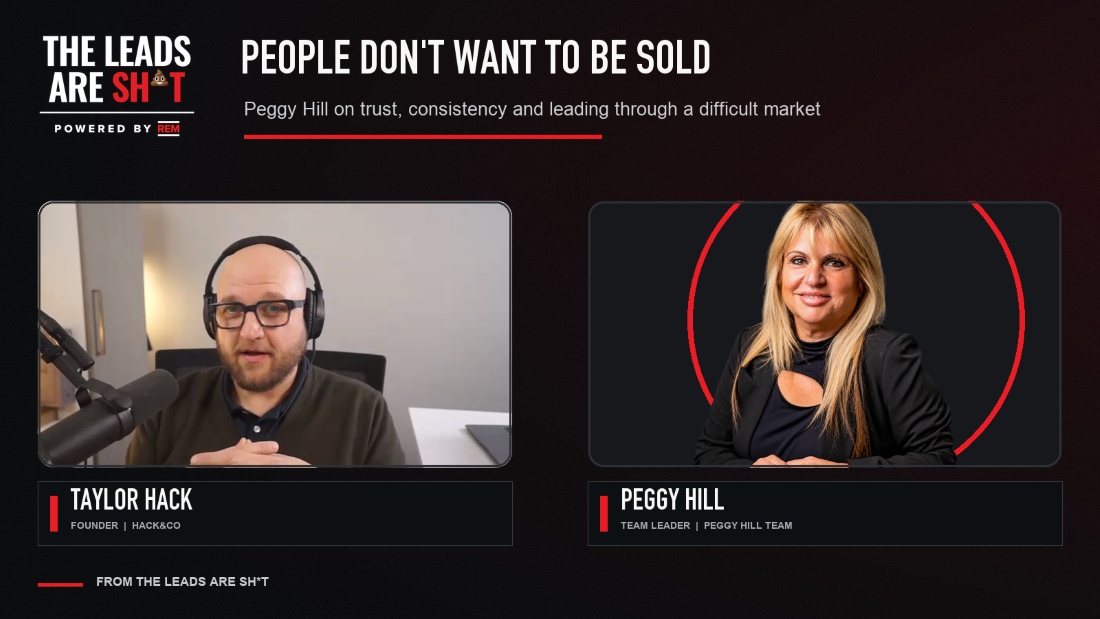
“My bigger conversation right now is how do we keep the consumers’ trust and faith that we can lead them through this messy time,” she told Taylor Hack during a recent episode of The Leads Are Sh*t.
Hill leads a real estate team of approximately 60 people in Ontario. She has adopted AI inside the business and says it has reduced administrative costs. Still, she keeps returning to a more basic competitive advantage: people want an experienced human being who cares about what happens to them.
That matters even more when the market becomes difficult.
Consistency has to outlast the tactic
Hill built her early business through open houses. Not one open house when a new listing appeared. Not a short campaign that ended when the immediate results were disappointing.
She said she did four open houses every weekend for five years.
“Five years. Never missed a weekend,” Hill said. “Nothing you do for a month is going to work.”
That is a useful correction for an industry that frequently evaluates a long-term activity using short-term evidence. An agent tries video for several weeks, sends one round of direct mail or hosts a few open houses and concludes that the tactic does not work.
The problem may not be the activity. The problem may be that the activity ended before the market had enough time to notice.
Repeated open houses created more than immediate buyer conversations for Hill. They made her visible. People saw her again and again, began to recognize her and eventually felt as though they already knew her.
That familiarity helped make future conversations easier. It also changed how people perceived her position in the market. The repeated presence created momentum before she had the listing inventory or established brand people later associated with her.
Face-to-face contact is becoming more valuable
Open houses can feel like an old tactic in an industry increasingly focused on automation, online lead generation and AI. Hill believes that is exactly why they remain valuable.
People arrive in a relatively relaxed environment. They are there to see a home, ask questions and understand the market. The agent has an opportunity to be helpful before asking for anything.
Hill is particularly critical of agents who immediately ask visitors whether they are already working with a Realtor.
That question may qualify the lead, but it can also end the relationship before one has started.
Her alternative is uncomplicated: befriend people, be kind, tell the truth and do what is right.
“They don’t want to be sold,” Hill said. “What they want is somebody that actually gives a shit about them.”
The language is blunt because the distinction matters. Caring about someone is not the same as performing concern until the transaction closes. Consumers can usually feel the difference.
Once people believe the agent cares about the outcome, the sales pressure becomes less important. Trust is doing the work.
AI can improve the operation without becoming the value proposition
Hill is not avoiding AI. Her team is using it to help load listings, select photos, complete virtual staging and interact with agents internally. She also said the technology has allowed the business to save the equivalent of multiple salaries.
Her hesitation is not about whether AI can make the operation more efficient. It is about confusing operational efficiency with the reason a client hires an agent.
“At the end of the day, this is all a people business,” she said.
AI can organize information. It can generate content and handle repetitive tasks. It cannot reproduce the full value of experience that has been tested through thousands of conversations, difficult listings, failed offers and changing markets.
The technology may raise consumer expectations rather than lower them. If basic information becomes available instantly, agents will be challenged more often and expected to explain their recommendations more clearly.
That means expertise has to move beyond knowing the statistics.
Consumers need insight, not another chart
Near the end of the conversation, Hill made one of the episode’s most important distinctions.
Consumers are not looking for more statistics. They are looking for vision and leadership.
A market report can show what happened. A capable agent must explain what those numbers mean for a particular buyer, seller or property. The agent must identify where the client is now, where the market appears to be going and what options are available.
Hack described it as the difference between seeing a map and seeing the marker that says, “You are here.”
That is where human judgment becomes valuable. Statistics are observations. Insight provides orientation.
Hill said she now follows information, including the bond market, that she did not need to understand at the same depth 20 years ago. The standard has changed because the market has changed and consumers have access to more information.
Agents cannot respond by repeating numbers their clients can already find. They need enough knowledge to speak honestly about what is happening and enough confidence to lead someone through it.
Leadership also applies inside the team
Hill describes her role as making it rain and taking care of her people so they can take care of clients.
Some members of her team have remained for more than seven years. Others have been there for more than a decade. She says experienced agents do not stay only because of a commission arrangement. They stay because they believe in the mission, the team and the impact they can make together.
She compared leadership to the lead position in a flying V. The person at the front creates momentum that helps everyone behind them move forward.
That momentum becomes especially important in a difficult market. Agents are working harder, earning less and dealing with greater emotional pressure. Leaders cannot pretend those conditions do not exist. They have to help people understand the environment and find a productive way through it.
Stop waiting for the easier market
Hill’s final message to agents was not gentle.
“You’ve got to stop whining and you’ve got to start working,” she said.
The point is not that market conditions are irrelevant. Hill openly discussed falling values, expired listings and the pressure on agents’ mental health. The point is that difficult conditions do not remove the opportunity. They increase the amount of work, skill and consistency required to reach it.
For Hill, the current opportunity remains surprisingly traditional:
Talk to people face to face. Become the educator in your community. Understand the market well enough to be honest about it. Keep showing up after the first month fails to produce the result you wanted.
Most importantly, give people a reason to believe that you care about what happens to them.
Technology will keep changing. Markets will rise and fall. The tools agents use to communicate will continue to multiply.
Trust still has to be earned one interaction at a time.
Join the conversation live
The Leads Are Sh*t is a weekly strategy lab where Andrew Fogliato and Taylor Hack break down what is working, fix what is not and test ideas inside an actual real estate business.
Join the show live every Thursday at 2 p.m. ET to ask a question, take the hot seat and stay for the off-the-record After Show, which is not included in the replay.
Register once and save your spot for the next live session.
Related Posts

The work after you hit record is the real AI opportunity
Andrew Fogliato and Taylor Hack map the work between recording a video and publishing it—and explain why clear instructions, business context and human review still matter.

The niche nobody owns may be the niche nobody wants
Before investing in a real estate niche, test its turnover, economics and demand. Then build the data, language and audience to own it.
Show Recap: A free-running app just became our real estate content strategy
A surprising shift: a free‑running app now powers our real‑estate content, blending tech and market insights in a way you won’t expect.


Content by REM Bot has been created with the assistance of AI. Audio and video interviews, conducted by our team with real people, are transcribed and repurposed into text for those who prefer reading. REM Bot articles are reviewed by staff before publication to ensure factual accuracy and maintain editorial standards.