






This article was drafted using AI from a transcript of The Leads Are Sh*t. It was reviewed for accuracy and approved by REM publisher and show co-host Andrew Fogliato, then edited for publication by Courtney Zwicker.
Many real estate agents treat a YouTube channel like a filing cabinet. A buyer video goes in. Then a market update. Then a seller tip, a recruiting message, a listing tour and an interview with a mortgage professional.
Every video may be useful on its own. Together, however, they may create a problem: the channel no longer makes a clear promise to anyone.
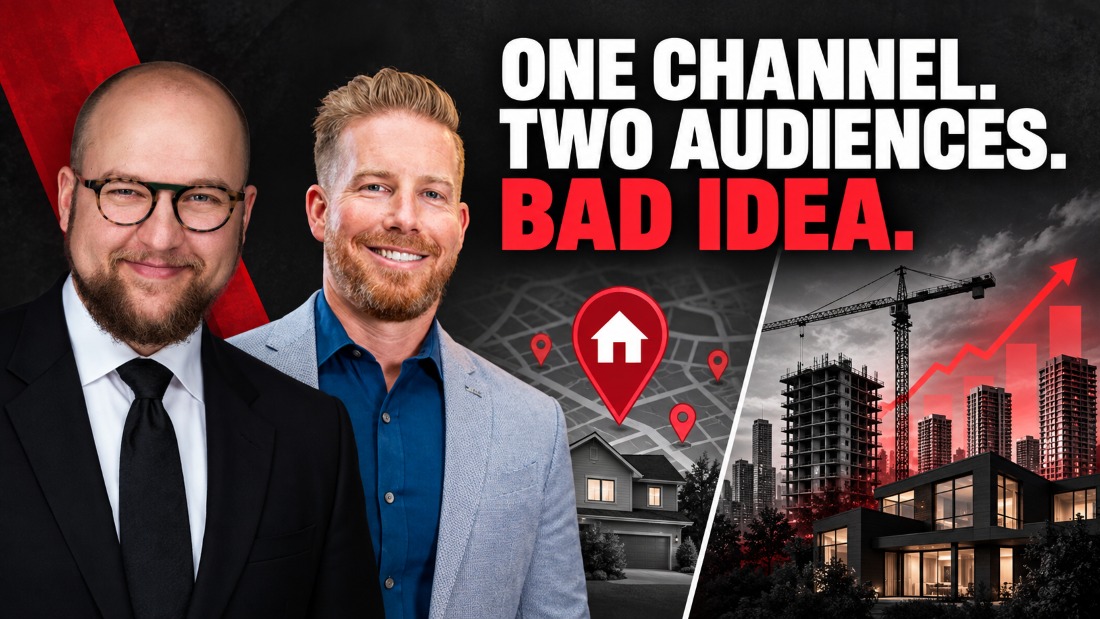
That was one of the central ideas when real estate agent and YouTube strategist Levi Lascsak joined Taylor Hack on The Leads Are Sh*t. Lascsak’s argument was direct: buyer, seller and agent content are different products for different audiences. When all three live in one place, viewers learn that much of what the channel publishes is not meant for them.
And when viewers learn to skip, the channel loses momentum.
A channel is a promise, not a résumé
Lascsak draws a line between what he calls selfish-based marketing and service-based marketing.
Self-focused marketing begins with the agent: awards, transaction totals, designations and claims of being the local expert. Service-based marketing begins with the viewer: what are they trying to understand, avoid or decide?
Credentials still matter. They can reduce risk and support a decision. But they are rarely the reason a consumer starts searching. A relocating buyer may want to know how two suburbs differ. A homeowner may be worried that a new development will change the value or marketability of a property. An agent considering a team may want a business system.
Those are three different problems. The most useful video meets one of them directly.
Lascsak said that when prospects called his team, they did not begin by asking about awards or past production. They felt that they already knew him because his videos demonstrated that he understood the neighbourhoods they were researching. The content established relevance before a sales conversation began.
That is the practical value of a clear channel promise: viewers know what they will get, and the right prospects can keep watching until they are ready to act.
Why mixed audiences weaken a channel
Imagine that a buyer subscribes after watching a detailed tour of a Dallas suburb. The next upload is about preparing a home for sale. The one after that is about joining a real estate team. Neither is relevant, so the buyer skips both.
Now imagine the same pattern from a seller’s perspective. That homeowner may care deeply about a new highway, school, mixed-use development or competing subdivision. They may have little interest in a relocation tour designed for an out-of-market buyer.
The issue is not that one topic is better than another. It is that each asks for attention from a different person.
Lascsak said he eventually separated his seller content from his established buyer channel. The seller channel focused on what was happening in Dallas: new developments, infrastructure, communities and other changes that could affect a homeowner’s decisions or property value.
At first, the new channel appeared to do very little. For roughly six months, it did not deliver the response he expected. Then it began producing results. During the episode, Lascsak said it generated 30 seller leads in one week and helped his team take more listings this year than in the previous five years combined.
The lesson is not that every agent needs three channels tomorrow. It is that content strategy should follow audience intent. When the intended viewer, problem and next step are materially different, a separate channel can create a cleaner experience.
Build a buyer channel people can binge
For buyer content, Lascsak offered a repeatable four-video structure for each neighbourhood or suburb:
- A neighbourhood tour: Show what it feels like to move through the area.
- A map tour: Explain geography, commute patterns, nearby amenities and how the area connects to the wider market.
- Pros and cons: Help a buyer understand the trade-offs without pretending every area is right for everyone.
- A listicle: Answer a practical search question, such as the things a buyer should know before moving there.
The power is not just in any individual video. Together, the videos form a mini-series. A serious buyer can move from general interest to a more informed preference without leaving the channel.
That creates a better viewer experience and a better lead. By the time a prospect contacts the agent, the early education has already happened. The call can begin further down the decision path.
This approach also makes content planning less intimidating. An agent does not need a brand-new creative concept every week. One community can support several useful videos, and the same framework can be repeated across a market.
Seller content is local intelligence
Seller videos require a different lens. A homeowner is not simply looking for a generic list of staging tips. Often, the more valuable question is: what is changing around my property, and what might that mean for my next move?
That opens a wide range of topics:
- New residential communities that may create future competition
- Infrastructure projects that could improve or disrupt access
- Commercial developments that may change how an area is perceived
- New model homes and builder inventory
- School, transit and zoning changes
- The likely timeline of a major local project
During the episode, Lascsak described videos about Dallas-area developments and highways. The strongest versions do more than report local news. They translate it into a decision: should an owner sell before new inventory arrives, wait until an amenity is complete or do nothing at all?
That final step separates a real estate video from a news summary. The agent adds value by explaining why the development matters to a homeowner.
Consistency is not the same as stubbornness
The seller channel’s slow beginning led to another important distinction: quitting versus quitting strategically.
Good content systems need time to create a catalogue, generate viewer signals and improve. Abandoning a clear, well-supported strategy after a few uploads may simply prevent the system from having a chance to work.
At the same time, consistency does not mean repeating an ineffective approach forever. Agents should examine whether the audience is clear, the topics match real search or local interest, the packaging earns attention and the videos hold it. The strategy can remain consistent while the execution improves.
Lascsak reduced the formula to two priorities: publish consistently and get better at presenting. He views video as a sales presentation delivered one-to-many. The camera becomes the client, which means the agent’s job is to communicate clearly—not become a full-time video editor.
His blunt advice for agents trapped in post-production was to hire an editor. Editing can often be delegated. The agent’s local knowledge, perspective and on-camera trust cannot.
The leverage comes from the system behind the video
A popular video is not the finish line. The business needs a process for answering inquiries, qualifying prospects and delivering the experience the content promised.
Lascsak described a partnership in which he focuses heavily on creating content while others help serve clients. The more useful videos the team publishes, the more versions of him are effectively answering questions and introducing the business around the clock.
That is where video changes from promotion to leverage. A cold call happens once. A useful local video may work for months or years. It can educate one person or thousands without requiring the agent to repeat the same presentation each time.
A practical way to start
An agent considering YouTube does not need three channels and a studio on day one. A simpler starting point is:
- Choose one audience. Decide whether the next 12 weeks are for buyers, sellers or agents.
- Write one channel promise. Complete the sentence: “This channel helps ___ understand ___ so they can ___.”
- Create one repeatable series. For buyers, use the four neighbourhood formats. For sellers, explain local changes and the decisions they may create.
- Block a sustainable recording window. Batch episodes when possible and protect that time.
- Improve the presentation. Study the opening, clarity, pacing and call to action before worrying about cinematic production.
- Build the follow-up process. Decide who answers, how inquiries are qualified and what happens next.
- Split the audience when the promise splits. If a meaningful share of uploads is irrelevant to existing viewers, a second channel may be warranted.
The goal is not to publish more content for its own sake. It is to become more useful to a clearly defined person.
That is the larger point behind Lascsak’s three-channel strategy. Buyers, sellers and agents do not merely need different video titles. They bring different questions, anxieties and decisions. When the content respects those differences, the marketing feels less like a broadcast and more like service.
Join the conversation live
The Leads Are Sh*t is a weekly strategy lab where Andrew Fogliato and Taylor Hack break down what is working, fix what is not and test ideas inside an actual real estate business.
Join the show live every Thursday at 2 p.m. ET to ask a question, take the hot seat and stay for the off-the-record After Show, which is not included in the replay.
Register once and save your spot for the next live session.
Related Posts
Tom Storey has been getting leads from AI. Here is what he found out about them.
Tom Storey spent several months optimizing for AI search, and it worked – leads started coming in. Storey joined Taylor Hack to break down what those leads actually look like, where they rank as a source of business, and what he is building to convert them.

The Canadian Real Estate May 2026 Market Breakdown
Housing analyst Daniel Foch breaks down May 2026 market trends, examining inventory growth, mortgage stress, affordability challenges and signals shaping Canada’s housing outlook.
Google changed search. Here is what agents should do about it.
Google made AI mode more prominent in search this week. For agents who have built their online presence around informational content, that changes the math on how buyers and sellers find them.



Content by REM Bot has been created with the assistance of AI. Audio and video interviews, conducted by our team with real people, are transcribed and repurposed into text for those who prefer reading. REM Bot articles are reviewed by staff before publication to ensure factual accuracy and maintain editorial standards.