






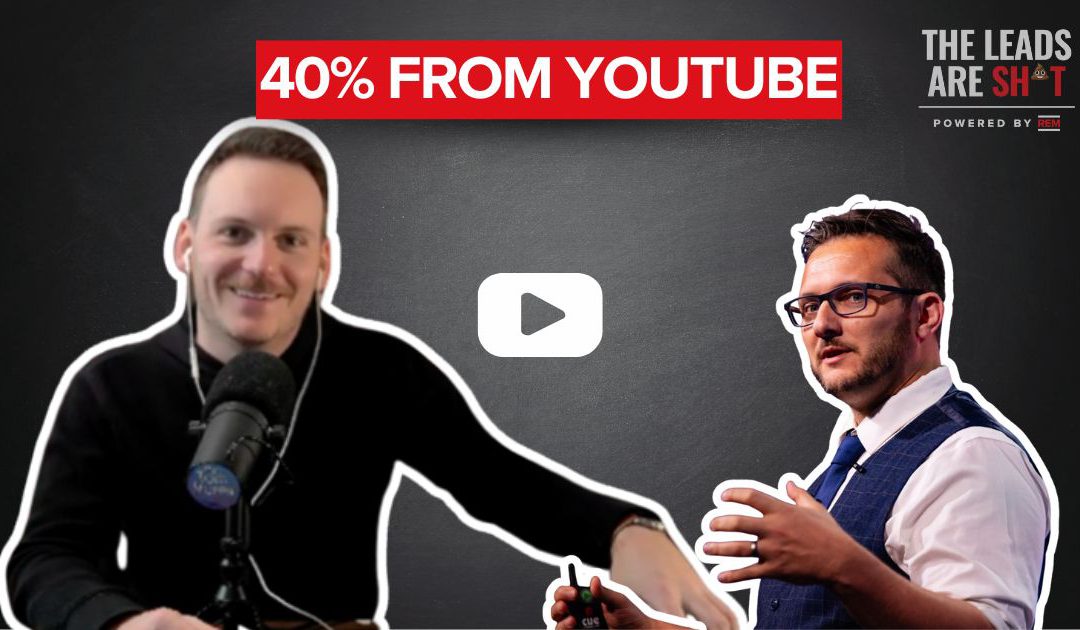
Many real estate agents say they are “doing YouTube.” Tom Storey treats it as a business system.
After more than a decade selling real estate in Toronto, Storey now attributes roughly 40 per cent of his business to YouTube. Not to short clips or paid ads, but to long-form videos designed to answer real buyer and seller questions in depth.
Storey recently joined The Leads Are Sht* as a guest co-host and outlined how his approach works, and why many agents struggle to replicate it.
What follows are the key takeaways.
Attention is easy. Trust takes time.
Short-form video can capture attention quickly. It rarely builds trust on its own.
Storey’s experience reflects a broader pattern seen across marketing and professional services. Clients usually need meaningful time with someone before they are ready to reach out. That time is not measured in likes or comments, but in minutes spent listening and learning.
For Storey, that trust is built through long-form YouTube videos that often run 30 to 60 minutes. The goal is not entertainment. The goal is clarity.
When someone books a call after watching an hour of content, the conversation starts from a very different place.
The video format that converts
Storey focuses on a small number of evergreen, high-intent videos rather than frequent uploads.
These videos cover topics such as:
- How to buy a first home in Canada
- How to buy a condo in Toronto
- Common buyer mistakes and how to avoid them
Each video is structured, practical, and designed to replace dozens of one-on-one conversations.
Storey compares them to buyer or listing presentations, made public. While the conversion rate may be slightly lower than an in-person meeting, the scale is far greater. Thousands of viewers can see the same explanation without Storey leaving his office.
Audience clarity matters more than production quality
One of the most common mistakes Storey sees is unclear audience focus.
Many agents post content aimed at consumers, other agents and industry peers on the same channel. The result is confusion for both viewers and algorithms.
Storey made a deliberate choice. His YouTube channel is for buyers and sellers. It is not designed for agent education or industry commentary.
That clarity has not eliminated referrals from other agents, but those referrals are a byproduct, not the objective.
Titles, thumbnails and honest curiosity
Strong content still needs to be discovered.
Storey uses research and AI tools to refine titles and thumbnails. If you’re going to use it to drive clicks with a big clickbait-style headline, follow this one rule. The video must deliver on what the headline promises.
There is a difference between creating curiosity and misleading viewers. If the content pays off the promise, trust grows. If it does not, credibility erodes.
Lead capture without pressure
In longer videos, Storey includes simple lead capture options.
A relevant guide is offered early in the video. It is mentioned again midway. Viewers who remain engaged are invited to book a call.
By that point, many viewers are already informed and confident. The video has done most of the work.
A system that compounds
Storey could generate business through cold calling, door knocking or constant posting. Those methods still work.
YouTube offers something different. It compounds.
A video published today can continue to build trust and generate clients years later. It functions less like social media and more like infrastructure.
The bottom line
Most agents do not fail at YouTube because they lack ideas or personality.
They fail because they treat it as content instead of a system.
Storey did not build a channel. He built a repeatable process that turns clarity into confidence and confidence into clients.
For agents looking to build leverage rather than chase the next tactic, the approach is worth studying.
Join the conversation live
Each week, The Leads Are Sh*t brings working agents together to dissect what’s actually working in real estate right now.
Be part of the live recording, get your questions answered and join the after-show conversation.
Related Posts

The Canadian Real Estate November Market Breakdown
Discover the latest trends impacting Canada’s housing market, from rental shifts to mortgage insights, and learn how these developments affect landlords, tenants, and real estate professionals alike.

The real estate referral system every agent needs in 2026
Unlock the secrets of a successful real estate referral system! Discover how to transform your approach with intentional strategies that boost your business in 2026.

How Realtors can turn listings into story-driven case studies
Transform your real estate approach by turning everyday listings into compelling stories that showcase your expertise and resonate with clients. Discover how to stand out in a crowded market!


Content by REM Bot has been created with the assistance of AI. Audio and video interviews, conducted by our team with real people, are transcribed and repurposed into text for those who prefer reading. REM Bot articles are reviewed by staff before publication to ensure factual accuracy and maintain editorial standards.