







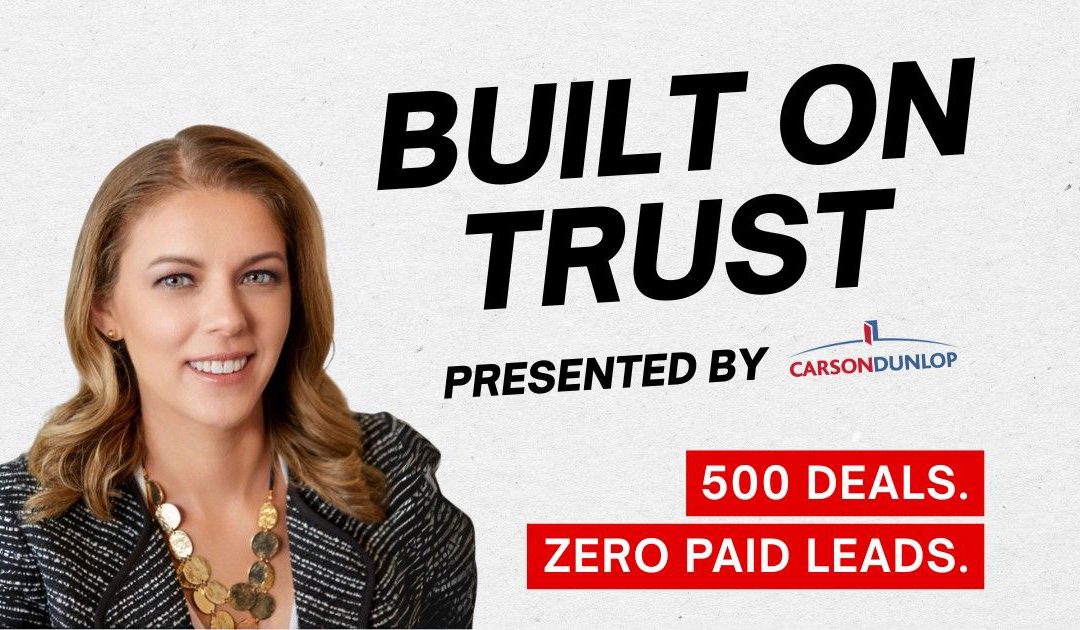
Carol Foderick has been in real estate for 25 years. In that time, she has worked at Royal LePage, led one of the top-producing teams in Canada at Keller Williams, and last summer launched her own brokerage, Signature Elite Realty. Through all of it, her business model has stayed the same: 100 per cent referral, zero paid leads.
Her group, the Carol Foderick Real Estate Group, currently has 22 agents operating in the Greater Toronto Area. They closed over 500 transactions last year. Every one of those deals started with a relationship.
Building a referral engine at scale
In this episode of Built on Trust, Foderick walks through the mechanics of how that works at scale. A past client in her system receives 65 touch points per year, a number that sounds aggressive until she breaks it down: home value updates four times a year, invitations to two client events, six educational masterclasses, personal notes, birthday acknowledgements, and the anniversary of their home purchase. The variety and intentionality of the contact is what keeps it from feeling like a sales pitch.
“If I called a past client 65 times in a year to ask them for a referral, that would be probably even past obnoxious,” Foderick says. “It’s probably criminal. But if I told you I was going to communicate information about the value of your home four times a year, invite you to client events, remember your birthday … all of a sudden that population of 65 touch points doesn’t feel so obnoxious anymore.”
Training agents and structuring support
New agents who join her group go through a 10-week launch program designed to teach them how to build and manage a referral database, time block their lead generation activities and operate within the group’s back-end systems. Foderick says agents who fully commit to the program have closed as many as 10 deals in their first 10 weeks.
The group’s administrative team is structured into specialized roles: a director of listing services, a director of closing services, a director of marketing, and even a director of lease closing services, because Foderick believes a client leasing a basement apartment deserves the same standard of service as one buying a $5-million home. She points to the group’s Google reviews, where clients frequently single out the administrative team by name, as evidence that the model works.
Adapting to market shifts while maintaining standards
On home inspections, Foderick says the market has shifted how her team uses pre-list inspections. In a multiple-offer environment, they were non-negotiable. In the current market, some buyers have started using pre-list reports to negotiate before conducting their own inspection, then negotiating again. As a result, her team now evaluates the decision on a listing-by-listing basis. On the buyer side, Carson Dunlop remains the default recommendation.
“They literally wrote the book on home inspections,” she says. “When I mention it to somebody who is new to the real estate experience, they can very easily do an online search and see that there is a reputational standard that exists for Carson Dunlop.”
Foderick’s broader message to agents is one of generosity. She says she spent two and a half hours on a call the day before the interview, helping an agent in Newmarket unpack her operational challenges. It was not a sales conversation.
“We don’t need to gatekeep our information as team leaders,” she says. “When we have information that we can share, we owe a care and due diligence to our industry to share what’s working well in this market.”
Watch the full episode now:



Built on Trust is a weekly video series produced by Real Estate Magazine and presented by Carson Dunlop.